 Main
Main Site Map
 Blog
Blog Calendar
 Gallery
 Site Traffic
 Site Health
> /Daniel/MRoadster/Upgrades/Suspension/SubframeBushingsindex.php
Installing Ireland Engineering Rear Subframe Bushings
Diary
- May 11, 2004
-
Subframe bushings
I picked up the following items:- 24mm GearWrench, 25mm GearWrench
- metric crowfoots (3/8" drive)
- satin black rust-preventative paint (oil-based)
- Craftsman 3/8" 10-75 ft-lb torque wrench
I touched up a few rust spots on the subframe and mount support brackets. I also touched up some spots on one of my springs.
I then raised the subframe (watching the driveshaft bolts and the suframe mounts), and installed the brackets. It's easiest to only insert the top part of the Ireland Engineering bushings before raising the subframe, so that you're not trying to get the mounting studs into the bushing at an angle. Once the subframe was up high enough, I reinserted the bolt in the differential cover mount. I then inserted the bottom half of the Ireland Engineering bushings, finishing their insertion by lightly tapping with a rubber mallet. I then attached the driveshaft and torqued the nuts to 64Nm using a 16mm crowfoot. I then installed the subframe mount support brackets, and installed the Butt-Strut.
The only fasteners that have been torqued to spec are the driveshaft and the subframe mount support brackets. Tomorrow I'll reinstall the springs, attach the shocks and swaybar, torque the differential cover mounting bolt, put the wheels back on, and set the car on the ground. I can then torque all of the rear suspension fasteners and the lugbolts, and take it for a test drive ride.
One thing I noticed... the wear pattern on the subframe mount brackets. The driver side showed almost no wear, while the passenger side had paint worn off in the shape of the bottom of the bushing rubber. This made it clear to me that the passenger side bushing is definitely seeing full deflection (webbing completely collapsing at times). It's not what I expected in comparing left-to-right, I was expecting the left one to show more wear due to the differential pulling downward on the left during acceleration. But there's no way to know for sure what's going on w/o measurements. The wear on the passenger side wouldn't be so evident if there wasn't dirt and mud getting between the bushing bottom and the bracket, and there's no way of knowing which side has seen more mud and dirt over time. So my observations could be misleading, but it looks like the whole subframe is rotating horizontally, pivoting around the driver side subframe mount. This can't easily happen with the Ireland Engineering bushings, there's a lot less initial compliance. I can't move the subframe with my bare hands like I could with the stock bushings.
The differential cover mount is definitely not designed to take horizontal twisting forces (nor fore-and-aft forces). If the subframe really is twisting horizontally, it would help explain differential mount failures. It doesn't do much for explaining the popped welds in the trunk floor and pulling the trunk pan away from the side rail. But since the diff cover is only mounted on the left side, any forces on it will be more significant on the left side of the trunk than the right.
-
Subframe bushings
- May 10, 2004
-
Subframe bushings
I disconnected the driveshaft to get more room to move the subframe. The only thing holding it in place now is the jack and the second pair of jackstands.I removed the stock bushings using the bushing removal toolkit. The first one went slowly, because the thrust nut and bearing moved up the threaded rod beyond the firm grip of my deep 24mm socket. I finished it with a combination wrench (wish I'd have bought a 24mm GearWrench yesterday). For the second one, I dried off the threads for the thrust nut part of the threaded rod and added a second bead of oil on the other end. That was enough to make the rod spin with the thrust nut, which let me use the 24mm deep socket for the whole removal. I used a hand ratchet because the air wrenches make the neighbor's dogs bark at this hour (midnight). Still quick and painless; I'm very glad I bought this tool instead of the BMW one.
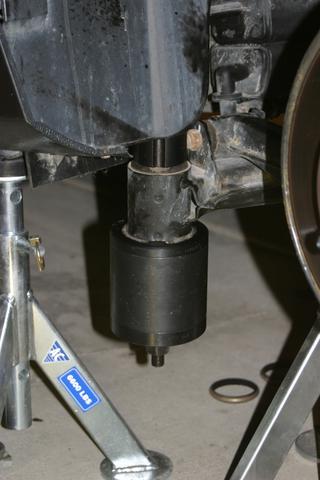
A picture of the tool positioned to remove the bushing on the driver's side:
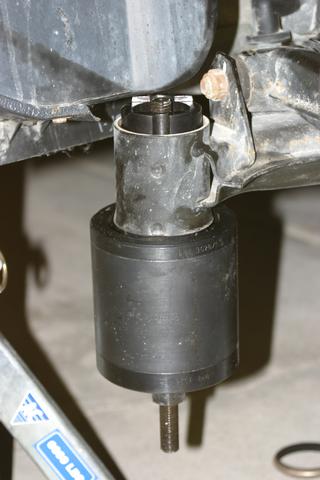
A picture of the tool in action:
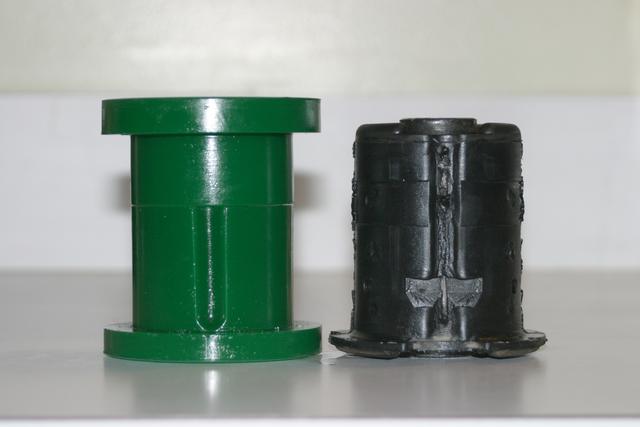
A picture comparing the total height of the Ireland Engineering bushing versus the stock bushing:
A picture of the Ireland Engineering bushing inserted in the subframe on the driver's side (done with no tools, just squeeze from top-to-bottom with bare hands):
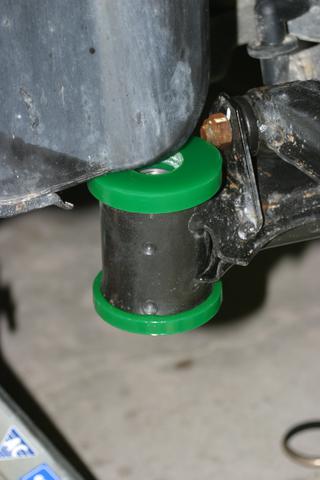
And the passenger's side:
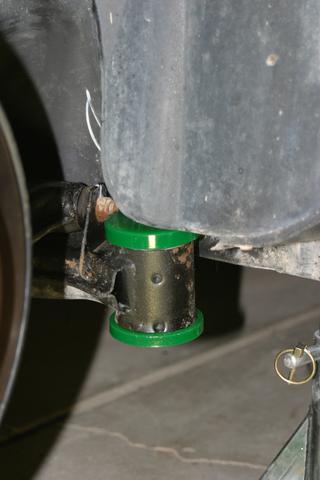
Noting the rust on this part of the subframe, I figured this was a good time to stop for the night. Tomorrow I'll clean it up and slap some paint on it. Sigh, the price I pay to live in a semi-secluded area on a dirt road. I might do a 3.73 LSD at the same time as the new suspension, which should be here in a few weeks. If I do, I'll pull the whole subframe out, clean it up and powdercoat it. I don't really care what it looks like, only that it doesn't rust. Having had a good look at the underside of the car for this season, I'm very glad I went with KW suspension; the strut housings are stainless steel. However, I think I've also concluded that dropping the subframe should be part of the fall pre-storage ritual; nothing is going to really protect it from living on a gravel road.
-
Subframe bushings
- May 9, 2004
-
Subframe bushings
I picked up some tools on the way to mom's. Bad idea; I got stuck in one-lane traffic on I-94, whichmade me late to mom's. Anyway, I got a set of external (i.e. female) Torx bits so I can remove the output shafts from the differential when desired, a new set of metric hex bits (since I was missing a few), and some more GearWrench metric combination wrenches since they were on sale for $40 for a set of eight.
-
Subframe bushings
- May 8, 2004
-
Subframe bushings
I lowered the subframe today. I wanted to see if I could get enough room to get the bushing removal tool in place without disconnecting the driveshaft. The answer is 'no'; the subframe will come down to the point where it's just off the mounting studs, but beyond that the driveshaft gets close to the exhaust x-pipe and wants the heat shield to be removed, not just unfastened. Even then it might hang up, I don't know how much downward range it has when the heat shield and exhaust x-pipe are removed.So tomorrow night or Monday night I'll work on disconnecting the driveshaft. Once the subframe is low enough, the rest is downhill thanks to having the SIR Tools bushing removal/installation toolkit.
I wanted to wait for the KW suspension to arrive so I could do the rear springs and shocks at the same time along with new rear shock mounts and especially the KMAC eccentric trailing arm bushings, but Laura is out of town this week so it's a good time for me to have two of the three bays of the garage to myself. The good news about having done this is that other future mods will be easier (KW V3 suspension, 3.73 LSD, SuperSprint exhaust, rear sway bar).
-
Subframe bushings
- April 21, 2004
-
Subframe bushings
The subframe bushings arrived from Ireland Engineering.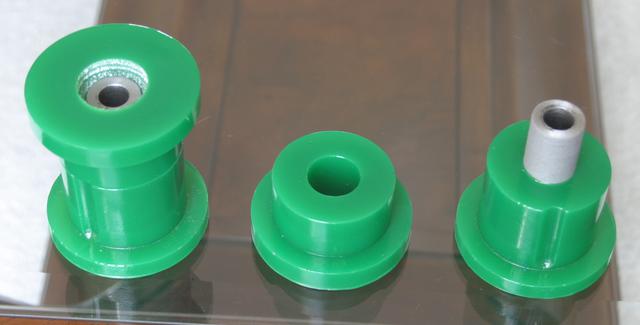
Some quick (rough) dimensions:
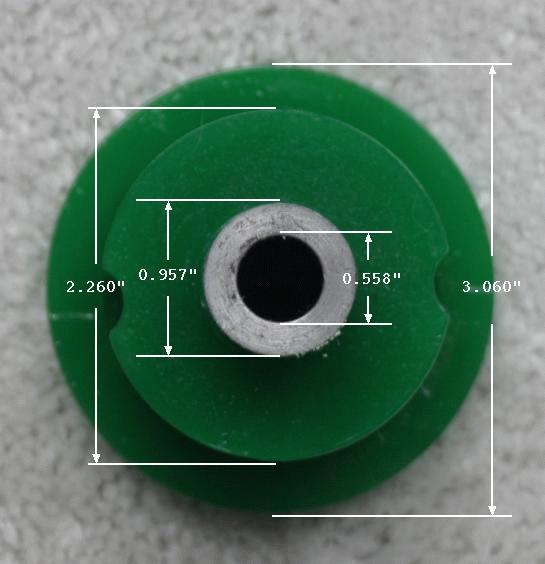
Overall height 3.580" Top lip thickness 0.500" Lower lip thickness 0.395" metal bushing length 3.310" urethane bushing diameter 2.260" urethane lip diameter 3.060" lower half urethane height 2.090" upper half urethane height 1.490" 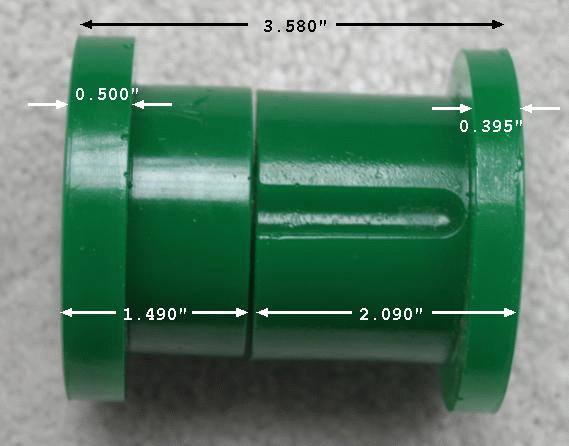
-
Subframe bushings
- April 12, 2004
-
Subframe bushings
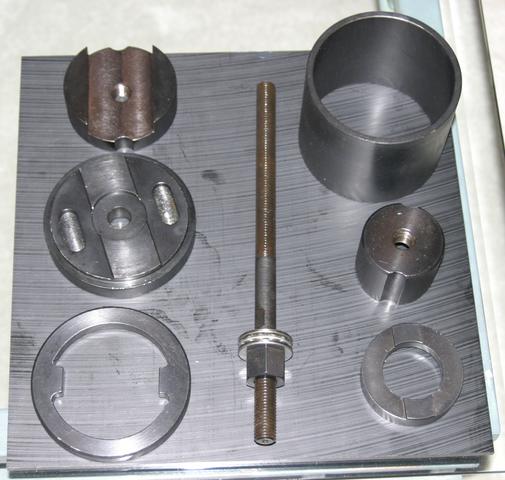
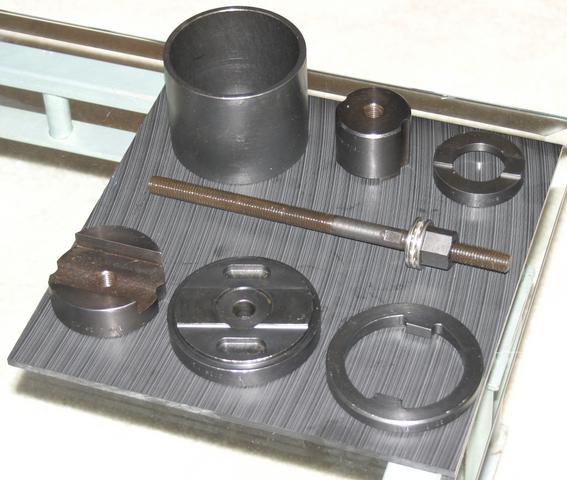
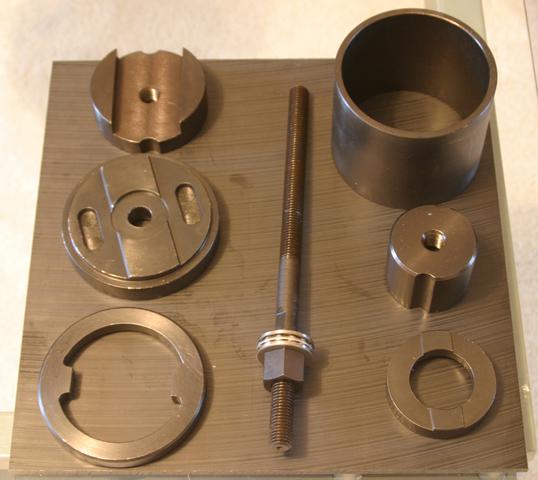
The subrame bushing tool kit arrived from ZDMAK. It's 12 pieces, but here are pictures of just the 7 pieces needed for our cars. For size reference, the parts are sitting on a 12" x 12" piece of .25" thick Delrin.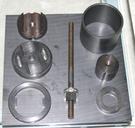
-
Subframe bushings
- April 1, 2004
-
Subframe bushings
I ordered the subframe bushing tool kit from ZDMAK. It's BMW3026 (Bushing Master Kit) on Page 1 of their BMW tools. $361, but it'll pay for itself in one or two uses. I'm hoping to have it before April 11, 2004 so I can bring it with me when I visit Randy.
-
Subframe bushings
- March 25, 2004
-
Subframe bushings
I ordered rear subframe bushings from Ireland Engineering. Hopefully they're taller than stock, and should be stiffer.
-
Subframe bushings